


Types of industrial robots - types and applications
Types of industrial robots include spherical, Cartesian, SCARA, articulated, cylindrical, Delta, and cobots, used in production automation. The right type of industrial robot determines how quickly, precisely, and safely production can be improved.
We offer cobots and complete robotic stations, which we design and manufacture for a specific, individual process and available workspace.
2016
Year of establishment of the company
+30
People on the team
+314
Implementation of automation and robotization projects
Free consultation
Let's see how robots can really help your business.
We will advise you and answer all your questions, show you the possibilities, benefits and return on investment time in your specific case.
How to Choose the Right Industrial Robot for Your Needs
Robot selection begins with an analysis of the task, not the device itself. We examine what the robot will be doing, what detail it will be working with, what the work environment looks like, and what effect the automation is expected to achieve. Only on this basis do we determine whether a collaborative robot, articulated robot, Cartesian robot, SCARA robot, delta robot, or another design will be a better solution.
When selecting types of industrial robots, we take into account, among other things, the mass of the object the robot will operate, the required range, the number of repeated movements, positioning accuracy, and the work rate. Available space, the method of feeding components, operator safety, and the possibility of future expansion of the station are also important.
Most important selection criteria:
-
Process nature - one solution will work well for welding, another for packaging, assembly, palletizing, or quality control.
-
Workspace - we select the robot to suit the machine layout, available space, and the points the arm must reach.
-
Technical parameters - we analyze the payload, reach, repeatability, speed, and type of end tool.
-
Operation and integration - we consider ease of programming, communication with machines, and operator comfort.
-
Thanks to this approach, the robot is not just a random element of the line, but part of a well-planned process. A properly selected design allows for increased efficiency, reduced errors, and better utilization of the production station's capabilities.
Thanks to this approach, the robot is not just a random element of the line, but part of a well-planned process. A properly selected design allows for increased efficiency, reduced errors, and better utilization of the production station's capabilities.
Types of Industrial Robots
Types Industrial robots vary in design, range of motion, and application. The most commonly used robots in industry are articulated robots, SCARA, Cartesian, cylindrical, and Delta robots, as well as cobots, which streamline production, assembly, and logistics. Below, we provide a more detailed description of each type.
Cylindrical Robot
A cylindrical robot performs rotational movements around its base and linear movements. Its workspace resembles a cylinder. It is suitable for simple, repetitive tasks such as part handling, palletizing, machine tending, or selected assembly processes.
Spherical Robot
A spherical robot, also known as a polar robot, combines rotational and linear motion. It operates in a space resembling a section of a sphere. It can be used where the arm needs to reach various points around the base.
Cartesian Robot
A Cartesian robot moves along simple linear axes, most often X, Y, and Z. It is easy to program and works well for positioning, part handling, measuring, and simple automation processes.
SCARA Robot
The SCARA robot is designed for high-speed operation in the horizontal plane. It is often used in assembly, packaging, sorting, and pick and place operations. Its advantages include speed and good movement repeatability.
Collaborative Robot
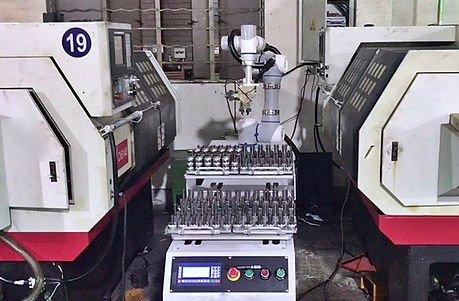
A collaborative robot, or cobot, is designed to work in close proximity to humans. It is distinguished by its simple operation, flexibility, and safety features. It is suitable for assembly, quality control, packaging, screwing, gluing and machine operation.
Stationary and Mobile Robots
Stationary robots are mounted in one place and operate within a defined workspace. They are most often used at fixed stations, for example, for machine operation, assembly, welding, palletizing, or workpiece storage. Their advantages include stability, repeatability, and easier planning of the entire process.
Mobile robots can move between plant locations, so they are primarily used in internal transport and production logistics. They can transport components, semi-finished products, or finished goods between stations. When implementing them, it is important to designate routes, communicate with the environment, and ensure employee safety.
Serial and Parallel Robots
Serial robots are constructed using sequentially connected links and joints. This arrangement allows for a great deal of freedom of movement, which is why it encompasses many popular designs, including Cartesian, SCARA, articulated, and collaborative robots. They are suitable for tasks requiring flexibility and work at various points within the workstation.
Parallel robots have multiple arms connected to a single work platform. This allows them to achieve high speed, dynamics, and accuracy. They are most often used for the rapid handling of lightweight workpieces, sorting, packaging, and precise positioning.
Industrial robots vary in their design, range of motion, and method of working with workpieces. The design of a robot influences its application, so different solutions are suitable for assembly, packaging, welding, palletizing, or machine operating.
Articulated Robot
An articulated robot consists of several rotary axes, making it move like a human arm. It is highly versatile and can work at various angles. It is used for welding, gluing, grinding, palletizing, and machine operating, among other applications.
Delta Robot
A delta robot has lightweight arms connected to a moving platform. This design allows it to achieve high operating speeds. It is most often used for sorting, packing, and quickly moving small items.
We provide complete implementation of industrial robots in your company.
We offer not only robots, but a full service: consulting, technology selection, installation, configuration, on-site assembly, training, and service. Thanks to this, the client receives a ready-to-use solution, not just a device that requires independent commissioning.
Scope of our cooperation:
-
Technical consulting - we assess the process, risks, and limitations of the station.
-
Integration - we select grippers, tools, sensors, and safety elements.
-
Training - we prepare operators for operation, changeovers, and basic programming.
-
Service support - we help maintain the station's efficiency and develop it along with production.
We implement various types of industrial robots with specific results in mind: greater repeatability, better ergonomics, more stable quality, and lower manual labor costs. Already at the process analysis stage, we check which activities burden employees the most, where downtime occurs, and which production areas are most prone to errors resulting from fatigue or changing working conditions. This allows us to design a workstation that not only automates the selected stage but also truly organizes the entire process.
We design each workstation to be understandable to operators, convenient for daily use, and expandable in the future. We ensure intuitive controls, logical arrangement of work elements, and easy access to key functions.