


Industrial Robot Arms
Modern production automation is based on solutions that truly increase efficiency and improve safety.
We provide ISO-certified industrial robot arms (ISO 13849-1, ISO 10218-1, ISO/TS 15066) for safe operation with humans. Robot prices start at PLN 10,190 (MG400 series), PLN 21,000 (M1 PRO series), and PLN 58,900 (CRA series).
2016
Year of establishment of the company
+30
People on the team
+314
Implementation of automation and robotization projects

Free consultation
Let's see how robots can really help your business.
We will advise you and answer all your questions, show you the possibilities, benefits and return on investment time in your specific case.
Industrial robot arms - the most common applications in practice
An industrial robot arm is a tool that will prove useful not only in large corporations, but also in small and medium-sized manufacturing and industrial companies. Robot arms flexibly adapt to numerous tasks in the production process. This allows companies to gain greater control over production while reducing operating costs. The solutions we provide are intuitive to use, and their implementation is smooth and uninterrupted.
Our company designs, manufactures, and implements effective automation solutions that streamline processes, reduce errors, and maintain stable production quality. We provide comprehensive services – from needs analysis to implementation of the robot arm and entire station, to technical support.
Robot arms - why choose us?
Cooperation with RoboSaveX (a GM Automatyka brand operating since 2016) provides access to engineers' experience, confirmed by over 314 implementations of robotic arms and industrial automation. We offer solutions that develop with your business and allow you to flexibly respond to changing market needs.
Customized Solutions
We analyze each robot arm and its implementation in the context of a specific process. We take into account the specifics of the industry, working conditions, and business goals, allowing us to achieve maximum efficiency and avoid unnecessary costs.
High quality and reliability
The robot arms we supply operate in a stable and repeatable manner, which translates into production quality. Dobot robot arms are resistant to intensive use, yet stand out for their exceptional precision, ensuring repeatability of 0.02 mm and a certified mean time between failures (MTBF) of at least 30,000 hours.
Over 300 implemented projects in the industrial automation and mechanical engineering industries
Over the years, we have solved hundreds of real-world problems, and we have already worked through many scenarios and tested them in practice. We design solutions to be as simple as possible. This allows operators to quickly learn how to work with the system, and the company can quickly achieve full production efficiency.
Ongoing technical support
We provide service and consulting even after implementation, so the customer is never left alone with the technology. We guarantee a 24-hour technical response, which helps maintain business continuity and minimize downtime.
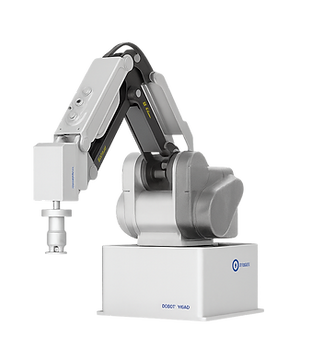
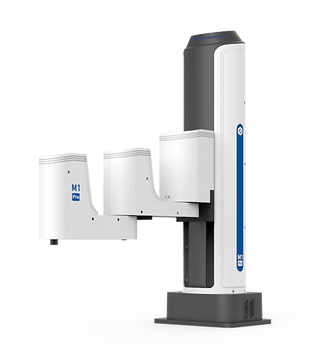
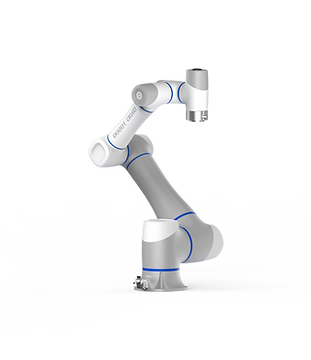
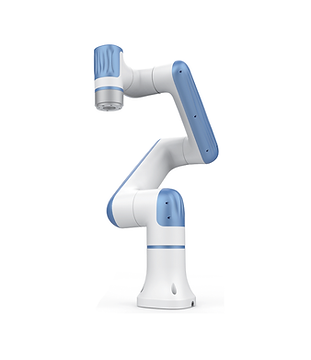
Technical parameters - payload, reach, and comparison of the CRA, MG400, NOVA, and M1 PRO robot series
Parametr | CRA | NOVA | M1 PRO | MG400 |
|---|---|---|---|---|
Number of axles | 6 | 6 | 4 | 4 |
Accuracy | Up to 0.02 mm | 0.05 mm | 0.02 mm | 0.05 mm |
Lifting capacity | Up to 20 kg | Up to 5 kg | 1.5 kg | 0.5 kg |
Reception | Up to 1700 mm | Up to 850 mm | 400 mm | 440 mm |
Robot arms price and product list
Robot arms prices start from PLN 10,190 for the MG400 series and PLN 21,000 for the M1 PRO series. If you need a robot with a higher payload capacity (up to 20 kg) and a longer reach, the Dobot CRA series starts at PLN 58,900. You can find prices for individual models in our store - check prices in our store.


Industrial robot arm - examples of implementations in various industries
Industrial robot arms include, among others: welding robots, palletizing robots in logistics, and precise bin-picking systems integrated with vision systems and vibratory feeders. Modern robot arms are used in many areas of production because they combine precision with flexibility. In welding processes, they allow for the achievement of repeatable and durable joints, while simultaneously reducing the impact of the human factor on workmanship. Automation of this stage translates into greater efficiency and work safety.
In production logistics, the industrial robot arm is ideal for palletizing and loading and unloading. This allows for the acceleration of internal transport and the reduction of the physical burden on employees. These systems operate smoothly and can operate continuously.
In assembly processes and operations such as screwing, gluing, or inserting components, robot arms ensure high accuracy. This is particularly important in mass production, where every detail must meet specific quality standards.
In turn, in tasks requiring analysis, such as quality control or bin picking, an industrial robot arm enables quick and precise detection of irregularities. As a result, the company can maintain high product standards and reduce losses resulting from production errors.
Benefits of using robotic arms
Automation of production processes using robotic arms allows you to shorten the production cycle time by 15-40%. Thanks to high repeatability, it is possible to maintain consistent quality regardless of the production scale.
The most important factors influencing production acceleration:
-
Precision and repeatability - each work cycle is identical.
-
Speed of operation - shorter execution time of individual operations.
-
Automation of repetitive tasks - reducing the workload of employees.
-
Process stability - reducing errors and downtime.
-
Energy efficiency - lower costs operational.
In practice, the robot arm eliminates many of the limitations associated with manual work. It can operate continuously, maintains precision, and requires no downtime, which directly impacts the efficiency of the entire plant.
We provide technical advice before purchasing a robotic arm implementation.
During the consultation, we consider aspects such as the required payload, reach, and the specific nature of the operations being performed. This ensures that the industrial robot arm is tailored to the specific conditions, not the other way around.
We also provide advice on integration with existing production systems. By assessing the plant's technical capabilities, we propose solutions that do not require costly infrastructure reconstruction.
As a result, the customer receives not only a product, but above all a well-thought-out automation concept that truly streamlines production and increases its profitability.
Industrial robot arms with comprehensive implementation
A comprehensive RoboSaveX implementation includes design, assembly, sales of robots and other components (including their production), integration with the production line, and operator training. After selecting the solution, we move on to the implementation phase, where we install the robot arms directly at the customer's facility. We ensure that the implementation process is quick and does not disrupt ongoing production.
We configure the systems according to technological requirements and integrate them with existing production lines. This allows the robot arm to start working in optimal conditions from day one.
Scope of activities:
-
Installation of devices at the workplace.
-
Configuration of control systems.
-
Integration with the production line.
-
Testing and optimization of operation.
-
Training of operators and technical staff.
We conduct training in a practical manner, allowing participants to quickly acquire the skills necessary for independent operation and programming.
After implementation, we remain available to the client, offering technical support and service. This approach allows us to maintain production continuity and develop the system in line with the company's needs.
After the robot arm implementation, we provide ongoing support for the implemented solution. Our support includes both ongoing technical assistance and measures to prevent potential downtime.
We ensure that each robot arm operates stably in the long term. A well-designed workstation ensures that robot arms will operate efficiently and reliably. This allows the company to focus on achieving its goals without worrying about unplanned downtime.
As part of our collaboration, we also offer the development of existing systems. As production needs change, we adapt the configuration, expand functionality, and introduce improvements. This ensures that the industrial robot arm does not lose its usefulness as the company grows.
FAQ - Questions and Answers - Industrial Robot Arms
Do robot arms require regular servicing?
The Dobot robot arms we offer do not require the classic, cyclical maintenance activities associated with traditional mechanics, such as regular lubrication or belt replacement. This reduces maintenance work and helps maintain production continuity without unnecessary downtime.
What if the robot arm fails?
We act quickly and specifically - we start with a diagnosis and replace the component that is actually causing the problem. In Dobot robot arms, we can precisely pinpoint the faulty part. In most cases, this avoids the costly replacement of large component assemblies. Replacing the entire joint is a last resort rather than a standard repair procedure.
If the robot cannot be repaired and returned to service within 7 days, we will provide a new replacement robot. The damaged arm is then taken to a service center for in-depth diagnostics and repair.
What is the availability of spare parts for repairs?
Components for the robot arms are available from warehouses in Germany, so parts delivery and replacement are usually possible the next business day.
What is the warranty on the Dobot industrial robot arm?
The standard warranty is one year of full warranty and an additional 6 months are usually taken for commissioning and implementing the robot. There is an option to extend the warranty to a total of 5 years for an additional fee.
Can the robot arm be used for another process later?
Yes. One of the greatest advantages of robot arms is the ability to change their use as production develops.
An arm that is currently used for welding may in the future be used, for example, for assembly, packaging, palletizing, operating CNC machines, gluing, screwdriving or quality control. This usually requires changing the equipment, e.g., a torch for a gripper, and adapting the program and station components.
The prepared station can be a starting point for further automation, instead of locking the company into a single process.
Will the robot arm be suitable for more complex tasks?
Yes - we select the arm model for the specific task, detail, and required accuracy. Depending on the series, 4- and 6-axis robots are available, with varying payload capacities, reach, and repeatability.
6-axis models are well-suited for applications where the tool must approach the workpiece at a specific angle, avoid obstacles, or move in multiple planes. This is useful for applications such as welding, assembly, gluing, inserting components, and operating machines.
For simpler, faster tasks such as pick and place, part feeding, or small parts assembly, 4-axis robots are often sufficient and more economical. On this website, we show series from the compact MG400 to the 6-axle CRA with a load capacity of up to 20 kg.